
- Guides
- Passage planning
Watch Systems for Two-Handed and Short-Handed Passages
Everyone can divide twenty-four hours by the number of crew. What almost nobody does on paper is ask which skills are awake at three in the morning.
Get the free Watch Roster Card See the Watchkeeping Roster & Night Passage Log
5 min readApex Marine Labs
Your free Watch Roster CardBy email, or downloaded now with no email needed. Fillable, US Letter and A4.
Get the free cardIn this guide 8 parts
Every crew can divide twenty-four hours into watches. What almost nobody does on paper is check which skills are actually awake at each hour. A rota where the only people who can reef, navigate or deal with the engine are all asleep between midnight and dawn looks fair and works perfectly, until the night it does not.
Short-handed crews have the hardest version of this problem, because there is nobody spare. This guide sets out how to build a watch system around people rather than hours.
01 / 08
Which watch system should you choose?
The one that fits your crew and your passage, tested on paper before departure.
Crews use many patterns: fixed blocks of equal length, shorter watches at night and longer ones by day, systems that shift each day so nobody always has the darkest hours, and informal arrangements on two-handed boats where the off-watch sleeps whenever possible. Each has advocates, and each suits some crews and passages better than others.
Which one is right for you depends on how many you are, how experienced, how long the passage is and how each person sleeps. No article can choose it. What you can do is test the choice on paper before departure.
02 / 08
How do you check which skills are awake at each hour?
Lay a grid of who can do what over your rota.
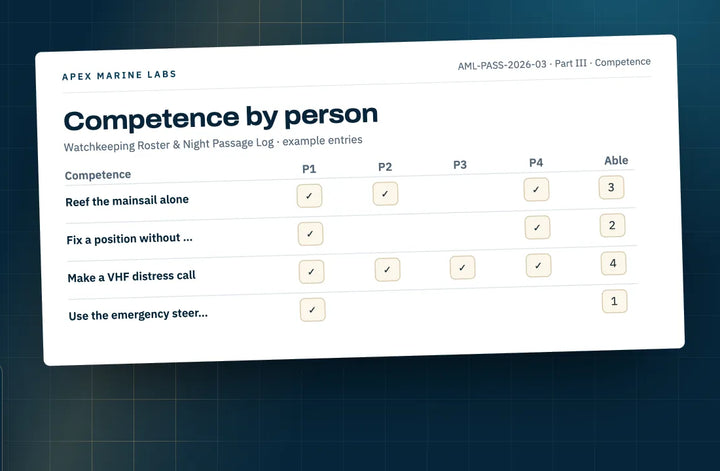
List the tasks that may need doing at night: reefing, changing a headsail, navigating in traffic, handling the engine, dealing with a man-overboard. For each crew member, note which they can do alone, which with help and which not yet. Then lay that grid over your rota.
The gaps appear immediately: hours when nobody awake can do a task that might be needed. Either change the rota, or use the time before departure to train somebody. A gap found ashore is a training plan; found at sea, it is a problem.
Free card, by email
Watch Roster Card
The watch plan in seven steps, who can do each night task alone, your standing rules, a seven-day roster that counts its uncovered slots, and an hourly night log with a handover line.
We email you both editions, US Letter and A4. Fillable in Adobe Acrobat Reader, free on iPhone, Android or computer.
Where should we send it?
The card now, one short note about five days later, nothing else unless you ask. Unsubscribe in one click.
03 / 08
When should the person on watch call the skipper?
Whenever a standing rule written before departure says so.
Write down the rules every watch follows: when the skipper or the off-watch must be called, what may be done alone on deck after dark, whether harnesses are clipped on at night, who may wake whom. For each rule, note where it came from. Rules agreed calmly are followed; rules invented in the moment are argued about.
Clear calling rules matter most on short-handed boats, where waking the only other person aboard feels like a big decision. A written rule removes the hesitation.
04 / 08
What happens if one of the crew is out of action?
Whatever you wrote down for that case before departure.
Seasickness, injury and fatigue change a rota within days. Note in advance who covers which slots, and which tasks are no longer covered at night. On a two-handed boat, this is the plan for single-handing, and it is worth writing down before it is needed.
05 / 08
What should each night watch log?
A short entry and a handover line. Position, course and speed, wind and sea, sails set, traffic seen, anything noticed or done, and the handover to the next watch. The handover line is what makes a short-handed system work: the person coming on deck learns in one minute what the last watch learned in three hours.
The watch plan sits inside a wider passage plan; see planning your first offshore passage, and for coastal hops, what goes in a float plan.
06 / 08
What should you record before departure and at sea?
Most of it before you leave, so the rota is tested ashore rather than at three in the morning.
| What to record | When | Why it matters | Where in the Watchkeeping Roster |
|---|---|---|---|
| Each night task, and who can do it alone, with help or not yet | Before departure | Competence is what keeps a watch safe, not hours | Competence by person |
| The rota you chose, laid over that grid | Before departure | The gaps only appear when the two meet | Roster and cover |
| Each hour with a gap, and what you will do about it | Before departure | A gap found ashore is a training plan | Gaps |
| Standing rules for calling the skipper, with their source | Before departure | Rules agreed calmly are followed | Rules |
| Position, course, speed, wind, sea, sails and traffic | Every night watch | A record that is useful during the passage and after it | Night log |
| The handover line | At the end of each watch | The next watch learns in a minute what you learned in hours | Handover |
07 / 08
What does this guide not tell you?
How long watches should be, how much rest a crew needs or which system is safest.
Those depend on your crew, your passage, your training and, where they apply, your race or regulatory requirements. The roster and night log are in the Watchkeeping Roster & Night Passage Log, part of the passage planning templates.
08 / 08
Frequently asked questions
What is the best watch system for two people sailing?
There is no single best system; it depends on the passage, how each person sleeps and their experience. Whatever pattern you choose, check on paper which skills are awake at each hour and agree clear rules for when to wake the other person.
Is my watch system reasonable for two people?
Judge it on who is awake and what they can do, not on how it compares with a published pattern. No general figure answers this for your boat; lay each person's night competences over the rota, mark every hour when nobody awake can reef, navigate or handle the engine, and note how you will close each gap before departure.
How do you plan night watches on a sailboat?
Choose a rota, map each crew member's competences against it to find hours when nobody awake can reef or navigate, agree standing rules for calling the skipper, plan for someone being out of action, and keep a short log with a handover line for each watch.
When should the person on watch wake the skipper?
Whenever a standing rule agreed before departure says so. Writing those rules down in advance removes hesitation, especially on short-handed boats.
How do you stay alert on a night watch?
With written rules and a routine that gives each watch something to do and record. Agree before departure when the skipper must be called, keep the night log at the times you set, note each handover with the time, and record hours slept each day. How much rest a crew needs is a question for a medical practitioner, not for this guide.
Free card, by email
Take the Watch Roster Card with you
We email you both editions, US Letter and A4, to fill in when you need it.
The card now, one short note about five days later, nothing else unless you ask. Unsubscribe in one click.
Or download it now:US LetterA4
The full record: Watchkeeping Roster & Night Passage Log. A roster can look fair and still leave nobody awake who can reef.
See the 35-page logThe document behind this method
A roster can look fair and still leave nobody awake who can reef.
On a conventional watch bill the gap is invisible: everyone gets their hours, the night is covered, and the only two people who can put in a reef are both asleep at the same time.
The Watchkeeping Roster & Night Passage Log makes the gap visible ashore. Standing rules for when the skipper is called and what may be done alone after dark, slots you define across the day, competences mapped against every slot, and a night log for what each watch actually saw.
It publishes no rest requirement, no watch length and no rule of its own. Each standing rule carries a column for where it came from: your training, your club, your insurer, your own experience.
Built before departure, it is the plan the crew sleeps on.
Watchkeeping Roster & Night Passage Log
This guide's recordWatchkeeping Roster & Night Passage Log
See the 35-page log