
- Guides
- Engine & drivetrain
Raw Water Cooling: What to Log Before Your Engine Overheats
The raw water circuit and the exhaust fail quietly, and then all at once. A fouled heat exchanger does not set off an alarm until the day it does. Both leave a trail, if anyone keeps one.
Get the free Raw Water Card See the Cooling & Exhaust Service Record
5 min readApex Marine Labs
In this guide 8 parts
Start here
The alarm is sudden.
What led to it may have taken seasons: a heat exchanger losing a little efficiency each year, a raw water pump impeller wearing quietly, an exhaust elbow narrowing with carbon. None of it announces itself until a hot afternoon at cruising revs when it all does at once.
This kind of failure can leave a trail, if somebody writes it down.
01 / 08
How does a raw water cooling circuit work?
In two loops, and every component in the raw water loop can restrict flow.
A closed freshwater loop carries coolant through the engine. A raw water loop draws seawater through a seacock and strainer, pushes it with an impeller pump through the heat exchanger, where it takes heat from the coolant, and then injects it into the exhaust at the mixing elbow to cool the gases before they leave the boat. Every restriction in that chain can show as a small change in temperature under load.
02 / 08
Why does the trend matter more than the alarm?
Because the trend shows what the gauge cannot.
An engine temperature gauge tells you where you are. It does not tell you where you were last season at the same revs, in similar water. That comparison is the whole value, and it only exists if somebody wrote down the first reading while the system was clean.
This is the same principle behind tracking engine hours and readings from day one: a reading is a state, a series is a trajectory.
Free card, by email
Raw Water Card
Nine things to record on your raw water circuit, a baseline line and seven trend lines that work out the rise and its drift against your own baseline, and an impeller log with the hours each one ran.
We email you both editions, US Letter and A4. Fillable in Adobe Acrobat Reader, free on iPhone, Android or computer.
Where should we send it?
03 / 08
When should you take the cooling baseline?
Right after a service, while the system is clean.
With a new impeller and a cleaned exchanger, take a set of readings at a few fixed RPM steps you can reproduce. Note sea temperature, the engine temperature your gauge shows, and anything else your installation lets you read. Write down the conditions. That set is the baseline every later reading is compared against.
What the temperatures should be is not ours to publish. They come from your engine builder's documentation, in the revision matching your serial number, and belong on a reference page beside the baseline.
04 / 08
What should you record at each service?
Every part of the circuit, with the engine hours beside it.
Hours are the only clock that means the same thing to every component.
| What to record | When | Why it matters | Where in the Cooling Record |
|---|---|---|---|
| Impeller: date, engine hours, part number and the state of the old one | At every change | Missing vanes go somewhere, usually into the heat exchanger | Impeller chronology |
| Strainer: when it was cleaned and what was in it | At every clean | What the strainer catches tells you what the circuit is facing | Service register |
| Heat exchanger: when it was serviced, what was found, who did it | At every service | Fouling is gradual, and only the history shows the rate | Service register |
| Anodes in the cooling circuit, if your engine has them | When checked | Their condition is part of the circuit's history | Service register |
| Exhaust elbow: inspected or replaced, and what the inside looked like | At every inspection | A narrowing elbow restricts flow long before it fails | Exhaust |
| Seacock and hoses: condition, and when last operated | At every inspection | A seacock that will not turn is found on the day you need it | Service register |
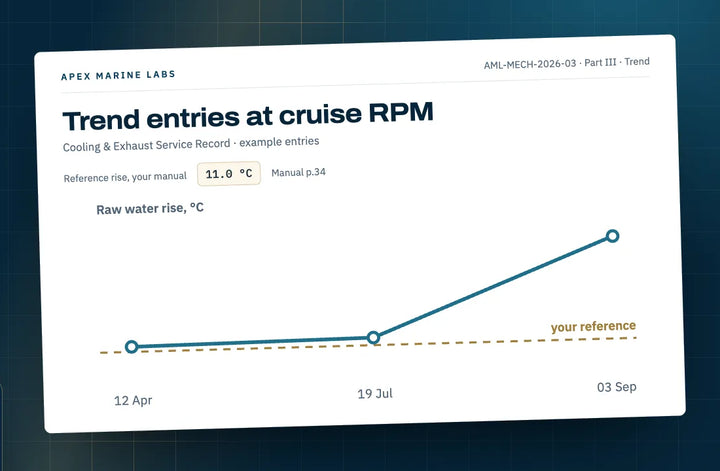
| Engine temperature at the baseline RPM step, with sea temperature | Under way, on every run | Drift at the same load, in similar water, is a change you can show your engineer | Trend entries, against the baseline |
05 / 08
What should you watch between services?
The raw water at the exhaust, and the temperature at your baseline step.
At the start of each run, check that raw water is coming out of the exhaust, and how strongly compared with usual. Under way, read the temperature at the same RPM step you used for the baseline, and note it with the sea temperature. A drift upward across a season, at the same load, in similar water, is worth a call to your engineer, with the record in hand.
Exhaust smoke, a change in the sound of the exhaust and salt deposits around the elbow are worth a line too. They are vague, and they belong in the record beside the readings.
06 / 08
Which other records sit beside it?
The shaft line, kept on the same clock.
The raw water circuit shares an engine room with the shaft line, and both are cheaper to look after than to repair. If your boat also needs a record for shaft alignment and the stern gear, the two are kept on the same clock. All three engine records are in the marine engine and drivetrain logs collection; the one for this circuit is the Cooling & Exhaust Service Record.
07 / 08
What does this guide not tell you?
What temperature is too high, how often to change an impeller or when an elbow must be replaced.
Those come from your engine manufacturer and your engineer. What it gives you is the history they will ask for, written down before anybody needs it.
08 / 08
Frequently asked questions
Why does a boat engine overheat?
Common causes include restricted raw water flow somewhere in the circuit: a blocked strainer or intake, a worn or failed impeller, a fouled heat exchanger or a narrowed exhaust elbow. Many of these develop gradually, which is why a dated record of readings at the same load is worth keeping.
How often should I change the raw water impeller?
Follow your engine manufacturer's documentation for your engine. What helps most is recording when each impeller went in, with the engine hours, so the next change is planned rather than remembered.
Should I keep the old impeller?
Yes, at least until you have recorded it. Note the date, the engine hours and the state of each vane, and keep a dated photo. If any vanes are missing, the pieces have gone somewhere in the circuit, usually toward the heat exchanger, so record that and ask a marine mechanic to find them before the next long run.
The engine overheats under load but the impeller is fine. What should I record?
Record the engine temperature and the RPM at a load you can reproduce, and compare them with your baseline. No general figure answers this for your boat; note the strainer's state, how strongly raw water leaves the exhaust, the sea temperature and the date. Then take that record to a marine mechanic, who judges the cause.
What should I check if no water comes out of the exhaust?
Your engine manual sets what to check and in what order, and the skipper decides when it is safe to stop the engine. Write down the time, the engine hours and what you saw, and give that line to your engineer.
Every step has its page in the Cooling & Exhaust Service Record. See the record →
Free records and cards for every system: Free guides.
Your next step
The full record: Cooling & Exhaust Service Record. Two systems that fail quietly. Keep the trail they leave.
See the 41-page recordThe document behind this method
Two systems that fail quietly. Keep the trail they leave.
An overheat alarm is the last line of a story that started seasons earlier. A heat exchanger fouling a little each year, an elbow carbonising, an impeller that was never changed because nobody wrote down when it went in.
The Cooling & Exhaust Service Record holds that story. A thermal baseline taken while the system is clean, trend entries against it, and the full chronology of every impeller, anode, strainer clean and exchanger service with the engine hours beside each.
It publishes no interval and no temperature of its own. Those come from your engine builder's documentation, and the reference page is where you transcribe them with the source and page.
Kept across seasons, it gives your engineer the slope behind an overheat, written down before anybody needed it.
Cooling & Exhaust Service Record
This guide's recordCooling & Exhaust Service Record
See the 41-page recordStart the log today, on your own engine
The reference page, the commissioning baseline and the trend log of the Marine Diesel Baseline & Trend Log, fillable in Adobe Acrobat Reader. Your latest entry is set against your baseline as you type.
Free, no email needed. PDF, fillable in Adobe Acrobat Reader.