
- Guides
- Ownership & admin
Boat Winterization Checklist for a Sailboat: The Record That Makes Spring Easy
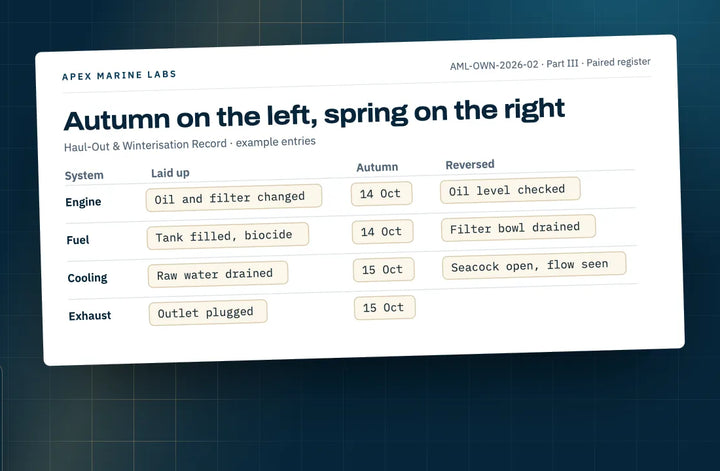
A boat winterization checklist for a sailboat is a record in two halves: what the hull showed in the slings before the wash, and every system closed, drained or removed in autumn, each with a spring column to tick when it is reversed. The procedure comes from your manuals; the record is yours.
Get the free Lay-Up Day Card See the Haul-Out & Winterization Record
6 min readApex Marine Labs
Your free Lay-Up Day CardBy email, or downloaded now with no email needed. Fillable, US Letter and A4.
Get the free cardIn this guide 8 parts
Winterizing a sailboat is not difficult. It is long, it is done in the cold, and it is done by somebody thinking about going home. That is why its typical failure is not a job done badly. It is a job done in autumn and never undone in spring: a seacock left closed, an impeller left out, an isolator left off, a vent left taped over. None of them announce themselves. All of them look exactly like a boat that is ready.
The fix is a record with two halves: what you found and did in autumn, and the line beside each one that you tick when it is reversed.
01 / 08
What should you record while she is in the slings?
The underwater hull exactly as the season left it, before the pressure washer erases it.
When the boat is lifted, it is visible for a few minutes. That is the best inspection of the year, and almost nobody writes it down.
Before the washing starts, photograph the hull and note what you see: fouling and where it is heaviest, the condition of the anodes and how much has wasted, the propeller, play at the cutless bearing, the rudder, the keel joint, any blistering. Compared with last year's photographs, these notes show trends that no inspection on a clean hull can.
The cutless bearing note belongs in the shaft alignment record too.
02 / 08
What does a boat winterization checklist record, system by system?
Every action, at the moment it is done, with its reversal beside it.
How to lay up each system comes from its manufacturer and your yard, not from a general checklist. The Haul-Out & Winterization Record keeps that pair for every system. What matters for the record is that nothing closed in autumn is left closed in spring.
| System | What to record in autumn | What to tick in spring |
|---|---|---|
| Engine | What was serviced, drained, treated or removed, following your engine documentation | Each one refitted or refilled |
| Raw water circuit | Impeller removed, seacock closed, circuit drained or protected | Impeller refitted, seacock opened, flow seen at the first start |
| Fresh water and heads | What was drained, flushed or protected, including the easy-to-miss outlets | Each outlet back in service |
| Electrical | Batteries charged, disconnected or removed; isolators off; anything left on, and why | Each one reconnected |
| Rig and sails | Mast unstepped or not, what came off and where it is stored | Each item back aboard |
| Openings | Every vent, hatch or opening taped, covered or blocked | Each one uncovered |
Sails going ashore should also be inspected and logged; the method is in tracking sail wear.
Free card, by email
Lay-Up Day Card
A free card for the day she comes out: eight lay-up steps in order, twelve observations of the hull as lifted, and a paired register where every autumn job shows Open until its spring reversal is dated.
We email you both editions, US Letter and A4. Fillable in Adobe Acrobat Reader, free on iPhone, Android or computer.
03 / 08
What is the reversal column?
A second column beside every lay-up line: reversed, by whom, when.
In spring, recommissioning is simply working through that column. An autumn line with no spring date is visible before she goes back in the water, with a place for who reversed it and when.
This single column is written for the most expensive spring mistakes: an engine started with the seacock shut, or with no impeller fitted.
04 / 08
What should you note over the winter?
A short dated line per visit.
Note what you find: rainwater, condensation, the state of the covers, battery condition if they stay aboard. It is the evidence an insurer or a yard will ask for if something goes wrong while the boat is ashore.
The same record will matter if you sell, because buyers ask a lot of questions: in our count of 500 boating forum search results on buying topics, 213 were questions (What Boat Buyers Ask Before They Buy).
05 / 08
How do you launch in spring?
With the record, not a memory.
Work through the reversal column. How the first start is run comes from your engine documentation; what to confirm and write down is in recommissioning a sailboat after winter. The first readings of the season are the ones to compare with last year's, in your engine log.
Winter costs are also part of what the boat costs to own; see what an hour afloat actually costs.
06 / 08
What should you record, and where?
Six things, from the slings to the first start, so the winter leaves a record rather than a memory.
| What to record | When | Why it matters | Where in the Haul-Out Record |
|---|---|---|---|
| The hull as lifted: fouling, propeller, cutless bearing, rudder, keel joint, blisters | In the slings, before washing | The best inspection of the year lasts minutes | Slings |
| Each anode and how much has wasted | In the slings | Compared year on year, it shows the rate | Anodes |
| Where fouling was heaviest | In the slings | A trend no clean hull can show | Fouling |
| Every lay-up action, with its reversal beside it | As you do it, then in spring | Nothing closed in autumn stays closed | Paired register |
| Work done ashore, by whom, and what was deferred | When it is done | The deferred list is next year's first page | Yard and work |
| What the winter cost | When the invoices arrive | Part of what the boat costs to own | Winter cost |
07 / 08
What does this guide not tell you?
How to winterize your engine, which products to use or what your yard requires.
Those come from your manufacturers' documentation and your yard. What it gives you is the record that nothing closed in autumn stays closed in spring. The record is the Haul-Out & Winterisation Record, in the ownership and admin collection.
08 / 08
Frequently asked questions
What should a boat winterization checklist for a sailboat include?
Four columns per system: what was done in autumn, who did it, when, and the spring reversal with its own date. Add the hull notes from the slings and a dated line per winter visit. What each system needs comes from its maker; the checklist keeps the record.
How do you winterize a sailboat?
Follow your engine and equipment manufacturers' documentation and your yard's requirements for each system, and record every action as you do it: what was drained, closed, removed or covered. Beside each line, keep a column to tick when it is reversed in spring.
What should I check when the boat is hauled out?
Before the hull is pressure washed, photograph and note fouling, anode condition, the propeller, play at the cutless bearing, the rudder, the keel joint and any blistering. Compare with previous years.
Should I leave the batteries on charge over winter?
Follow your battery maker's instructions for storage, because the right answer depends on the battery chemistry and the charger, and no general rule covers every boat. Record the choice you made: on charge, disconnected or taken ashore, and the charger setting if one is used. Then note the state of charge on every winter visit, with the date.
What is the most common mistake when recommissioning a boat in spring?
Leaving something closed or removed in autumn: a seacock shut, an impeller not refitted, an isolator off. A lay-up record with a reversal column for each action turns it into a line you tick in spring.
Your next step
Free card, by email
Take the Lay-Up Day Card with you
We email you both editions, US Letter and A4, to fill in when you need it.
The card now, one short note about five days later, nothing else unless you ask. Unsubscribe in one click.
Or download it now:US LetterA4
The full record: Haul-Out & Winterization Record. The line you closed in autumn and never reopened is the one that costs you in spring.
See the 36-page recordThe document behind this method
The line you closed in autumn and never reopened is the one that costs you in spring.
Winterisation is not a hard job. It is a long one, done in the cold, by somebody thinking about going home, and its failure mode is never the thing done badly. It is the thing done and never reversed: a seacock closed, an impeller removed, an isolator off, a vent taped over.
The Haul-Out & Winterisation Record holds both halves. What the hull shows in the slings before the pressure washer erases it, and every system closed, drained or removed in autumn, with a line for reversing it in spring.
It publishes no procedure and no product of its own. How to lay up your engine and systems comes from your manufacturers and your yard, and the reference page is where you transcribe it.
At relaunch, any line closed in autumn without a tick beside it is in front of you before she goes in the water.
Haul-Out & Winterization Record
This guide's recordHaul-Out & Winterization Record
See the 36-page record