
- Guides
- Ownership & admin
Recommissioning a Sailboat After Winter: What to Check and Record Before Launch
Recommissioning goes wrong in one predictable way: something closed in autumn is still closed at launch. Work system by system, confirm each item by sight rather than memory, and write every step down, from the lay-up lines to the first start.
Get the free Launch Day Card See the Haul-Out & Winterization Record
6 min readApex Marine Labs
Your free Launch Day CardBy email, or downloaded now with no email needed. Fillable, US Letter and A4.
Get the free cardIn this guide 8 parts
Recommissioning a boat in spring is the lay-up run backwards, plus everything the winter did while nobody was watching. It is rarely difficult. It goes wrong in one predictable way: something closed, removed or switched off in autumn is still closed, removed or switched off on the day she goes back in the water, and nobody finds out until the engine is running.
In Australia and New Zealand that day is now. This guide sets out the order to work in, what to confirm with your own eyes rather than from memory, and what to write down so next spring is shorter.
01 / 08
Why does recommissioning go wrong?
Because the autumn was not written down, or the list was not worked through.
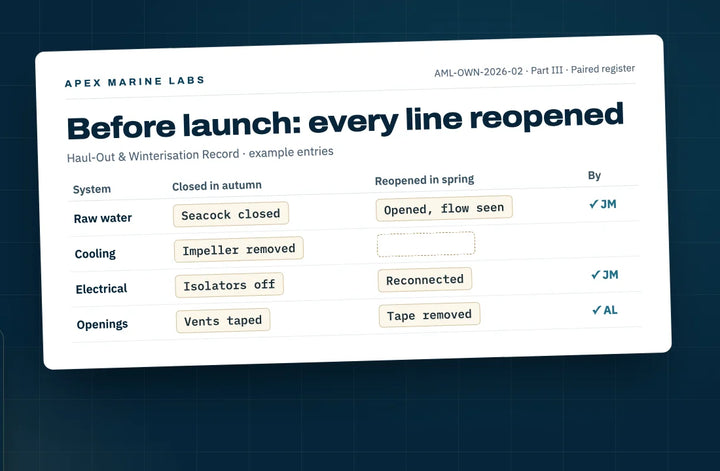
A seacock left shut, an impeller never refitted, an isolator still off, a vent still taped: each one looks exactly like a boat that is ready. The fix is the same every time. Every job done at lay-up has a matching line at relaunch, and a line with no tick is visible before she goes back in the water.
If you kept a lay-up record, recommissioning is simply working through its reversal column; the method is in winterizing a sailboat. If you did not, start below.
02 / 08
What if nobody recorded the lay-up?
Treat every system as unconfirmed until you have seen it yourself.
This is the usual position on a boat bought over the winter, or laid up by a yard. Walk the boat system by system and write down what you find, not what you assume: whether the impeller is fitted, which seacocks are open, what is connected. Where you cannot tell, write "unknown" and find out before launch.
The page you write this spring becomes the lay-up record for next autumn. That alone halves the work next year.
If she is a boat you bought over the winter, you are not the only one asking: of 686 question titles in our count of 2,000 boating forum threads, 61 mention a first boat, a first time, a new owner, a beginner or a newbie (our study of what boat buyers ask before they buy).
Free card, by email
Launch Day Card
Eight systems to confirm ashore and again afloat, the first engine start in order, what the winter left with its date, the yard work and deferred jobs with their quotes, days ashore, cost per day, and a launch sign-off.
We email you both editions, US Letter and A4. Fillable in Adobe Acrobat Reader, free on iPhone, Android or computer.
03 / 08
What should you check before she goes back in the water?
Each system twice: once ashore, where you can reach everything, and once afloat, where you can see it working.
What each system needs comes from its manufacturer and your yard; what follows is what to confirm and write down.
| System | Confirm ashore | Confirm afloat |
|---|---|---|
| Through-hulls and seacocks | Each one operates, and its hoses and clips are sound | No water where there should be none |
| Raw water circuit | The impeller is fitted, the strainer is clean and in place | Raw water at the exhaust within moments of the first start |
| Engine | Everything drained or removed in autumn is refilled or refitted, following your engine documentation | Readings at your usual revs, compared with last season |
| Underwater hull | Anodes, antifouling, propeller, cutless bearing, rudder | Nothing you noted ashore has changed |
| Fresh water and heads | Every drained outlet back in service | Pumps run and nothing leaks |
| Electrical | Batteries charged and reconnected, isolators set as you want them | Each charge source seen charging |
| Rig and sails | Everything that came off is back aboard and secured | Each sail hoisted once before you need it |
| Openings and covers | Every vent and opening uncovered | Ventilation working as it should |
The cutless bearing note also belongs in your shaft alignment record, and the date on every piece of safety equipment in your expiry calendar, before the first sail rather than after it.
04 / 08
What should you record at the first engine start?
What you saw, line by line, as it happened.
How the first start is run comes from your engine documentation and the skipper. The first start of the season is the moment the most expensive spring mistakes show themselves, which is why each line is written down at the time.
- The raw water seacock and the impeller as you saw them before the start: open or shut, fitted or not, by sight, not from memory.
- The hour meter, before the key turns.
- What came out of the exhaust after the start, and who was watching it.
- Once she is warm, the readings at the revs you use for your baseline, beside last season's.
Those first readings are the start of this season's series in your engine log. If you have never taken a baseline, the first warm run after a service is the moment to take it.
05 / 08
What did the winter do?
Whatever you find now, written down with the date.
Water where there should be none, condensation, damage to covers, chafe from wind on lines and covers, battery condition, anything disturbed. A short dated line for each is the evidence an insurer or a yard will ask for if something happened while the boat was ashore.
06 / 08
What should you record at relaunch?
Six things, so the season starts from a record rather than a memory.
| What to record | When | Why it matters | Where in the Haul-Out Record |
|---|---|---|---|
| Each lay-up line reversed, by whom and when | Before launch | Nothing closed in autumn goes in the water closed | Paired register, reversal column |
| Any system found in an unknown state, and what you did | On the first walk round | Next autumn's record starts here | Paired register |
| The underwater hull before launch: anodes, antifouling, propeller | The day before launch | The last look before it is out of sight for a season | Anodes and fouling |
| What the winter left: water, condensation, covers, batteries | On the first visit | Evidence for an insurer or a yard | Season sheet |
| Work done in the yard, and what was deferred | Before you leave the yard | The deferred list is this season's first page | Yard and work |
| The hour meter and the readings at the first start | At the first start | This season's series begins with it | With your engine log |
07 / 08
What does this guide not tell you?
How to recommission your engine, which products to use, or what your yard and insurer require before launch.
Those come from your manufacturers' documentation, your yard and your policy. What it gives you is the order to work in and the record that nothing was missed. The record is the Haul-Out & Winterisation Record, in the ownership and admin collection.
08 / 08
Frequently asked questions
How do you recommission a sailboat after winter?
Work through every job done at lay-up, system by system, and confirm each reversal by sight rather than memory. Confirm each system ashore, then again afloat, and write each step down, including what you saw at the exhaust on the first start. How each system is recommissioned comes from its manufacturer and your yard.
What should I check before launching my boat in spring?
Every job done in autumn, checked against your lay-up record, then each system confirmed ashore and again afloat: each seacock as you find it, what was removed and refitted, what was disconnected and reconnected, and what you saw at the exhaust on the first start. How each step is done comes from your manufacturers and your yard. Write each step down as it is done, with the date, so the record is complete.
What is the most common mistake when recommissioning a boat?
Starting the engine with something still closed or removed from the lay-up: a raw water seacock shut or an impeller not refitted. A record of what was done in autumn, with a line to tick for each reversal, turns it into a check rather than a memory.
What if I do not know how the boat was laid up?
Treat every system as unconfirmed. Walk the boat, write down what you actually find, mark anything you cannot confirm as unknown, and resolve it before launch. That page becomes your lay-up record for next autumn.
Your next step
Free card, by email
Take the Launch Day Card with you
We email you both editions, US Letter and A4, to fill in when you need it.
The card now, one short note about five days later, nothing else unless you ask. Unsubscribe in one click.
Or download it now:US LetterA4
The full record: Haul-Out & Winterization Record. Spring goes right when autumn was written down.
See the 36-page recordThe document behind this method
Spring goes right when autumn was written down.
Spring goes wrong in one way only: something closed, removed or switched off in autumn is still that way at launch, and nobody finds out until the engine is running.
The Haul-Out & Winterisation Record pairs every lay-up job with the line that reverses it, so recommissioning is a list worked through rather than a memory trusted. It also keeps what the hull showed before launch, what the winter left behind, and the work deferred into the new season.
It publishes no procedure and no product of its own. How to recommission your engine and systems comes from your manufacturers and your yard, and the reference page is where you transcribe it.
At relaunch, any line closed in autumn without a tick beside it is in front of you before she goes in the water.
Haul-Out & Winterization Record
This guide's recordHaul-Out & Winterization Record
See the 36-page record