
- Guides
- Buying a boat
Marine Survey vs. Pre-Purchase Inspection: What Each One Is For
A buyer's inspection and a marine survey are not competing for the same job. One decides whether the boat is worth a survey. The other judges her condition. Confusing the two costs money in both directions.
Get the free Survey Brief Card See the Boat Buyer's Due Diligence Kit
6 min readApex Marine Labs
Your free Survey Brief CardBy email, or downloaded now with no email needed. Fillable, US Letter and A4.
Get the free cardIn this guide 7 parts
A buyer's inspection and a marine survey are often discussed as if one could replace the other. They cannot, and they are not meant to. One decides whether a boat is worth paying a professional to examine. The other is that examination. Confusing them costs money in both directions: surveys commissioned on boats that should have been ruled out in an afternoon, and purchases made on the strength of an afternoon that should have been a survey.
01 / 07
What is a marine survey?
A marine survey is a professional assessment of a boat's condition by a qualified surveyor, delivered as a written report.
A pre-purchase survey, sometimes called a condition and valuation survey, usually has the boat hauled out for at least part of the work. Lenders and insurers commonly ask for one, and the report is the document a negotiation after survey is built on.
The surveyor brings training, instruments and accountability that a buyer does not. The judgement in the report is theirs. Requirements for who may survey and what a survey must cover vary by country, by insurer and by lender, so ask yours what they will accept before you book.
Buyers do ask about surveys: in our count of 100 boating forum search results about surveys and surveyors, 31 were questions, and the 18 buying questions about a survey or a sea trial drew a median of 26 comments (What Boat Buyers Ask Before They Buy).
02 / 07
What is a buyer's pre-purchase inspection?
A buyer's inspection is what you do yourself at a viewing, to decide whether this boat deserves a survey and to record what you saw.
It is not a survey and should never be presented as one. Its job is narrower and earlier, so that the survey, if it happens, starts from more than nothing.
Done properly, it follows a fixed order, so nothing is skipped when you are tired or distracted, and it is written down at the moment you see things. Our guide on what to bring to a boat viewing covers the kit and the five fields that make a finding usable.
Free card, by email
Survey Brief Card
Seven steps from viewing to survey on one page, what to agree with your surveyor before booking, and the Due Diligence Kit's survey brief: eight points you could not reach or referred, each with your question.
We email you both editions, US Letter and A4. Fillable in Adobe Acrobat Reader, free on iPhone, Android or computer.
03 / 07
How do a survey and an inspection compare?
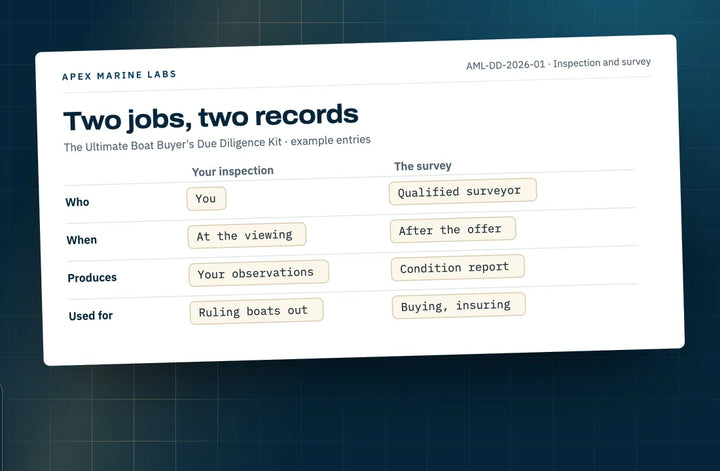
They answer different questions at different moments: the inspection decides whether a boat deserves a survey, the survey judges her condition.
| Your inspection | A marine survey | |
|---|---|---|
| Who does it | You | A qualified surveyor you instruct |
| When | At the viewing, before you commit money | After an offer is accepted, usually subject to survey |
| What it produces | Your record of observations and the questions they raise | A professional report on condition, often with a valuation |
| What it is for | Ruling boats in or out, and briefing the surveyor | The decision to buy, the negotiation, insurance and finance |
| What it is not | A verdict on condition | A guarantee about the future |
04 / 07
What should you record for your surveyor?
A legible brief: what you saw and where, what you could not reach, and what you want a professional to look at first.
| What to record | When | Why it matters | Where in the Due Diligence Kit |
|---|---|---|---|
| Each observation, with where you saw it | At the viewing, as you see it | A finding without a place cannot be checked | Inspection record, point by point |
| Every point you could not reach | At the viewing | It is where the survey should start | Survey brief, unreached points |
| Every point you refer to a professional | At the viewing | Your notes stay observations; the judgement stays the surveyor's | Survey brief, referred points |
| The severity you assign, as your own reading | The same evening | It ranks what to ask about first, without becoming a verdict | Severity class beside each finding |
| The surveyor's findings, once received | After the survey | Your record and the report meet in one place for the offer | Defect matrix and offer construction |
A surveyor working from that brief spends time in the right places. A surveyor working from nothing starts at the bow and works aft.
After the survey, the two records meet again. Your notes and the surveyor's findings become the basis for turning findings into an offer, and the sea trial record fills in what neither can see on the hard.
05 / 07
Which mistakes cost buyers money?
Three, and each one confuses the two jobs.
Skipping the survey because the inspection looked good. Your inspection can tell you a boat is worth surveying. It cannot tell you she is sound. Internal corrosion, laminate problems and hidden rigging faults are exactly what a survey exists to find.
Commissioning surveys without inspecting first. Every survey costs a fee and often a haul-out. An afternoon with a structured inspection rules out most of the boats that would have failed it.
Treating your own notes as findings of condition. They are observations. Keep them labelled as such, and let the qualified person judge.
06 / 07
What does this guide not tell you?
It does not tell you which surveyor to use, what a survey should cost or what standard it must meet where you are buying.
Ask your insurer and lender what they require, and ask the surveyor what their report will cover before you instruct them. The buyer's side of the work is carried by the Due Diligence Kit, alongside the other boat buying documents.
07 / 07
Frequently asked questions
What is the difference between a marine survey and a boat inspection?
A marine survey is a professional assessment of a vessel's condition by a qualified surveyor, producing a report used for the purchase decision, insurance and finance. A buyer's inspection is your own structured look at a viewing, used to decide whether the boat is worth surveying and to brief the surveyor.
Do I need a survey if my own inspection found nothing?
Yes, if you are serious about the boat. An inspection records what you could see. A survey is designed to find what a buyer cannot, and insurers and lenders often require one.
Is a survey worth it on a cheaper or older boat?
There is no price, size or age below which a survey stops mattering. What changes is what is at stake if a fault you could not see turns up after you buy. Set the survey fee and the haul-out against the repairs your own inspection could not rule out, and ask your insurer whether it will cover the boat without a report. Your viewing record is what makes that comparison concrete.
The seller says I don't need a survey. What should I do?
Keep your offer subject to survey. A seller's confidence in the boat is not an assessment of her condition, and an insurer or lender may ask for a report whatever the seller thinks. If a survey is refused, write that down with the date: it is information about the purchase in itself.
Can a surveyor miss something?
Yes. A survey reports what the surveyor could see and test on the day, within the scope you agreed. That is why your brief should list every point you could not reach and what you want looked at first, and why you should ask, before booking, what the report will and will not cover.
What should I give my surveyor before the survey?
A legible record of your viewing: what you saw, where, what you could not reach, and the questions it raised. It helps the surveyor spend time where it matters.
Your next step
Free card, by email
Take the Survey Brief Card with you
We email you both editions, US Letter and A4, to fill in when you need it.
The card now, one short note about five days later, nothing else unless you ask. Unsubscribe in one click.
Or download it now:US LetterA4
The full record: The Boat Buyer's Due Diligence Kit. Your inspection decides whether she is worth a survey. Make it a record the surveyor can use.
See the 77-page kitThe kit behind this method
Your inspection decides whether she is worth a survey. Make it a record the surveyor can use.
A surveyor judges condition. Your inspection decides whether a boat is worth paying a surveyor to look at, and it gives the surveyor a head start when she is.
The Boat Buyer's Due Diligence Kit is the buyer's half of that work. A fixed sequence of numbered observation points, run in the same order on every boat you look at, so two vessels can actually be compared. Each point has a line for what you saw, a finding and the severity you assigned at the time.
It does not tell you what a reading should be or whether to buy. It records what you saw, where, and how much it mattered to you on the day.
The result is a file you can hand to your surveyor and your broker, and the reason the survey you commission is spent on the right boat.
The Boat Buyer's Due Diligence Kit is one of the three records of the Boat Buying Command Kit, with the Sailboat Sea Trial Log and the Boat Purchase Budget Worksheet.
This guide's recordThe Boat Buyer's Due Diligence Kit
See the 77-page kit