
- Guides
- Buying a boat
How to Run a Sailboat Sea Trial, and What to Record at Each Step
A sea trial is the only part of a purchase that cannot be repeated later for free. Most buyers come home with a feeling. Here is the order to run it in, and what to write down so the feeling becomes a record.
Get the free Sea Trial Day Card See the Sailboat Sea Trial Log
7 min readApex Marine Labs
Your free Sea Trial Day CardBy email, or downloaded now with no email needed. Fillable, US Letter and A4.
Get the free cardIn this guide 8 parts
A sea trial is the only part of a purchase that cannot be repeated later for free. You get one afternoon, one owner or broker at the helm, and one set of conditions. If you do not write the day down as it happens, what you bring home is an impression, and an impression does not move a price.
The answer is not to look harder. It is to run the trial in a fixed order and record each step in a form you can compare: against the builder's data, against the survey, and against the next boat on your list.
01 / 08
What should you record before you leave the dock?
The cold start, first, because it cannot be repeated once she is warm.
Ask for the engine not to be run before you arrive, and say why. Smoke on start-up, how readily she fires, the sound before the oil reaches temperature: all of it disappears within minutes.
Record the hour meter before the key turns. Note what you see from the exhaust, whether the raw water flow is established and how quickly, and anything you hear that changes as the engine warms. Your own notes on what the manufacturer says about start-up belong on a reference page, written before the day, not remembered on the pontoon.
While you are still alongside, look at the things that are easiest to see when nothing is moving: the stuffing box or shaft seal, the engine mounts, the bilge. If the bilge is suspiciously dry or freshly cleaned, write that down too.
02 / 08
How do you run the RPM ladder?
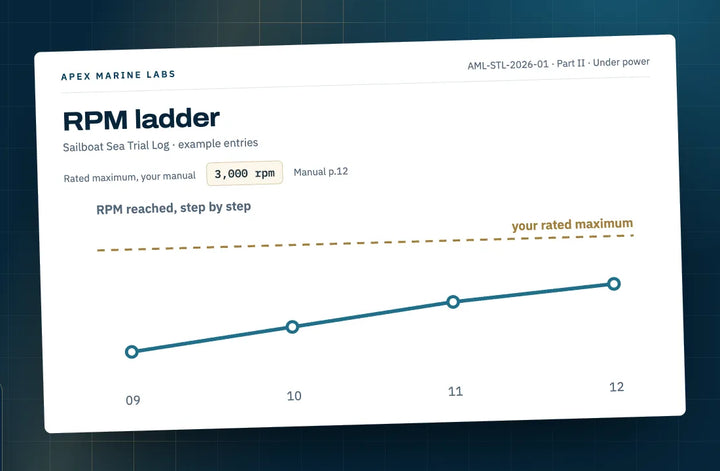
As a series of steps, each held long enough to settle, each recorded the same way, on both reciprocal headings. The core of a sea trial is not a top speed. At every step, note engine revs, speed through the water and over the ground, the temperatures and pressures your gauges report, and anything you can feel or hear.
A reading taken with the tide is not the same as one taken against it, and the average of the two is the only figure that describes the boat rather than the water she happened to be in. This is the step most buyers skip, and the reason most sea trial notes cannot be compared with anything.
What the readings should be is not for an article to say. The rated maximum revs, the expected temperatures and pressures all come from the engine builder's documentation for that engine, in the revision matching its serial number. Transcribe them beforehand so that on the day you are comparing, not guessing.
Free card, by email
Sea Trial Day Card
The seven steps of the day in order, with the two pages a trial cannot do without: the timed cold start and the RPM ladder on both headings, where the tide-free mean works itself out in Acrobat.
We email you both editions, US Letter and A4. Fillable in Adobe Acrobat Reader, free on iPhone, Android or computer.
03 / 08
What handling should you test?
The manoeuvres you will actually do every week, made as the skipper chooses.
Note how she holds a straight line astern, and whether she has a strong side when turning each way. If the skipper chooses to make a stopping run, as the gearbox maker's manual allows, note how long she takes to stop. A close approach to a pontoon, if conditions allow and the skipper agrees.
None of this produces a number that matters on its own. It produces the notes you will reread when you are deciding between two boats, and the questions you will put to the surveyor.
Buyers ask about every stage of a purchase, and the sea trial is one of them: in our count of 100 boating forum search results about sea trials, 25 were questions (our study of what boat buyers ask before they buy).
04 / 08
What should you look at under sail?
Every sail that comes with the boat, how it sets, and how she balances.
Hoist them all, not only the ones that are easy. Note how each one sets, how the reefing system works in practice, and whether lines run freely or need help. Sail her on every point of sail the conditions allow and record the helm feel on each.
Balance her and let go of the wheel or tiller for a moment. Weather helm, lee helm and how quickly she rounds up tell you a great deal about rig tune and sail condition. The full record of the wardrobe belongs in a sail register later; on the day, a line per sail is enough. Our guide to tracking sail wear explains what that later record looks like.
05 / 08
What should you ask the owner while you are out there?
What has been replaced and when, what has failed, and what they would do next if they were keeping her.
A sea trial is the best conversation you will have with the owner, because both of you have time and nothing to do with your hands. Write down the answers as they are given, and ask for the paperwork that supports them later.
The engine log, if there is one, is worth more than any reading you take on the day. A boat whose owner can show a record of engine hours and readings is a different risk from one whose history is a recollection.
06 / 08
What should you record, step by step?
Seven things, in the order the day happens, so the trial can be compared with the survey and with the next boat.
| What to record | When | Why it matters | Where in the Sea Trial Log |
|---|---|---|---|
| Hour meter, exhaust, raw water flow and sound on a cold start | Before the key turns, and as she warms | The one observation that cannot be repeated | Dockside |
| Shaft seal, engine mounts and the bilge | Alongside, before you leave | Easiest to see when nothing is moving | Dockside |
| Revs, speed through the water and over the ground, temperatures and pressures at each step | On both reciprocal headings | The mean removes the tide and describes the boat | Under power: RPM ladder |
| Astern, turns both ways, a stopping run if the skipper makes one, a close approach | Under power | The manoeuvres you will do every week | Under power: handling |
| How each sail sets, the reefing, the helm on each point of sail | Under sail | Rig tune and sail condition, before a sail register exists | Under sail |
| The owner's answers: what was replaced, what failed, what they would do next | While you are out there | Questions to check against the paperwork | Systems and close |
| The readings reduced to figures you can compare | The same evening | Two boats on two days, made comparable | Reduction sheet |
07 / 08
What does a sea trial not tell you?
Whether a reading is acceptable, whether a vibration is serious or what a repair will cost.
Those are judgements for a qualified surveyor and, where it matters, an engineer. What the trial gives them is a record they can work from, and what it gives you is the material for turning findings into an offer.
The sea trial is usually run alongside the survey, after the viewing. If you have not yet been aboard, start with what to bring to a boat viewing. The full set of buying documents is in the boat buying checklists collection, and the record for this day is the Sailboat Sea Trial Log.
08 / 08
Frequently asked questions
Should I insist on a sea trial before buying a boat?
Yes, for any boat you intend to use, sail or power. The sea trial is the only moment you see the engine start from cold and the boat working under load, and neither can be judged at the dock. If the seller refuses one, write that down with the date and the reason given, and tell your surveyor before you decide.
What should I check during a sailboat sea trial?
Check the cold start before the engine has been run, an RPM ladder held at steps on both reciprocal headings, handling astern and in turns, and every sail that comes with the boat. Record each observation as it happens, with the conditions beside it, so the day can be compared later.
Why run the engine test on reciprocal headings?
Because a reading taken with the tide differs from one taken against it. Averaging the two headings removes the effect of current and gives a figure that describes the boat rather than the water she was in.
What readings should the engine show on a sea trial?
That depends on the engine, and the figures come from the builder's documentation for that engine and serial number. Transcribe them before the trial so you compare the boat against her own specification rather than against a general rule.
The boat is far away. Can I rely on a video walkthrough?
Not on its own. A video shows what the seller chooses to film. Ask for a filmed cold start with the hour meter shown before the key turns, and a continuous walk through the bilge and engine space. Then keep the purchase subject to a sea trial and a survey carried out on site. The video is a reason to travel, not a replacement for it.
Is a sea trial a substitute for a survey?
No. A sea trial records how the boat behaves on one day. A qualified surveyor judges condition. The trial record gives the surveyor more to work with.
Your next step
Free card, by email
Take the Sea Trial Day Card with you
We email you both editions, US Letter and A4, to fill in when you need it.
The card now, one short note about five days later, nothing else unless you ask. Unsubscribe in one click.
Or download it now:US LetterA4
The full record: Sailboat Sea Trial Log. One afternoon you cannot repeat. Come home with figures, not a feeling.
See the 43-page logThe kit behind this method
One afternoon you cannot repeat. Come home with figures, not a feeling.
Most buyers step off a sea trial with a feeling: she sailed nicely, the engine seemed fine, something vibrated somewhere at some revs. None of that survives a negotiation, and none of it can be set beside the next boat you look at.
The Sailboat Sea Trial Log is built in the order the day actually runs. The dockside and cold-start sequence first, because it is the only observation that cannot be repeated once she is warm. Then the RPM ladder on reciprocal headings, sail handling, and the findings page your surveyor will ask for.
It publishes no temperature, no pressure and no speed of its own. Those belong to the builder and the engine manufacturer, and the reference page is where you transcribe them.
One day on the water, recorded line by line, so the boat can be compared against her own data, against another vessel, or against herself a year later.
The Sailboat Sea Trial Log is one of the three records of the Boat Buying Command Kit, with the Boat Buyer's Due Diligence Kit and the Boat Purchase Budget Worksheet.
This guide's recordSailboat Sea Trial Log
See the 43-page log